
Most people think more filler equals a bigger result. In reality, the difference between a treatment that genuinely lifts the face and one that simply adds volume – or worse, adds heaviness – comes down to three things: where you inject, how deep you inject, and what you inject. In this article, Dr. Vivek Singhal explains the science and technique behind fillerbased facial lifting, and why these decisions require considerably more expertise than most patients realise.
Why Filler Can Lift – But Often Doesn’t
Dermal filler has genuine lifting potential. Used correctly, it can restore facial support structures, reposition descended soft tissue, improve facial contour and create results comparable — in the right candidate — to a surgical lift. But this potential is only realised when three conditions are met simultaneously:
The right filler – with rheological properties suited to structural support, not just filling space.
The right injection point – anatomically specific locations that serve as structural anchor points for the overlying soft tissue.
The right tissue plane – the correct depth relative to skin, fat compartments, muscle and bone, so the product works with facial anatomy rather than against it.
Miss any one of these and the result is volumisation without lift – a fuller face, not a liftedone. Miss all three and the result can be actively counterproductive: heaviness, distortion and an appearance that looks treated rather than rejuvenated.
Part 1: Filler Rheology – What Is G Prime and Why Does It Matter?
When aesthetic practitioners talk about “high G prime” fillers, they are referring to a specific physical property of hyaluronic acid gel that determines how the filler behaves once injected into tissue.
G prime (G’) is the elastic modulus of the filler – a measure of its stiffness or resistance to deformation. In simple terms:
High G’ filler is firm, holds its shape under pressure and provides structural support. It resists the downward force of gravity and overlying soft tissue weight.
Low G’ filler is soft, spreads easily, integrates into surrounding tissue and is better suited to fine lines, lips and delicate areas where natural movement is important.
For lifting applications – cheeks, temples, jawline, chin – a high G’ filler is essential. Placing a low G’ product in a structural location does not provide lift; the soft gel simply deforms under the weight of the overlying tissue and spreads rather than supports.
Think of it this way: you cannot build scaffolding from soft clay. You need a material with enough rigidity to bear load and maintain position over time.
The selection of the appropriate product for each area is a clinical decision that requires an understanding of both the product’s physical properties and the anatomy of the target zone.
Part 2: Injection Points – Anatomy Is Everything
Knowing where to inject for a lifting result is perhaps the most underappreciated skill in aesthetic medicine. The face contains specific anatomical “keystone points” – locations where small amounts of well-placed filler create disproportionately large improvements in overlying tissue position.
These are not arbitrary injection sites. They are based on a detailed understanding of facial anatomy: where ligaments attach, where fat compartments are separated, where the bone provides a stable base for filler to act as a scaffold, and where gravity has the greatest downward effect.
Key Lifting Points
The Malar (Cheek) Eminence and Sub-Malar Region The mid-face is the engine of facial ageing. Loss of volume at the malar eminence allows the mid-face soft tissue to descend, creating hollowness under the cheekbone, deepening of the nasolabial folds and early jowl formation. Precise placement at the malar eminence – not above it or medial to it – restores the youthful triangular facial structure and provides genuine upward vector lift to the surrounding tissue.
The Zygomatic Arch (Lateral Cheek) Injecting along the lateral zygomatic arch provides lateral projection and can achieve a subtle but effective lateral lifting vector – pulling the mid-face tissue upward and outward rather than simply forward. This is a key distinction between a natural lifted result and the “filled” look.
The Pre-Periosteal Temporal Region Volume loss in the temples causes hollowing, loss of brow support and a skeletonised appearance. Restoring temporal volume also has a secondary lifting effect on the brow and lateral canthal area – achieved without placing any product near the eye itself.
The Pre-Periosteal Temporal Region Volume loss in the temples causes hollowing, loss of brow support and a skeletonised appearance. Restoring temporal volume also has a secondary lifting effect on the brow and lateral canthal area – achieved without placing any product near the eye itself.
The Chin Point The chin is a projecting anchor point for the lower face. Restoring or enhancing chin projection improves the overall facial proportions, reduces the relative heaviness of the lower face and creates the appearance of a more defined jawline without directly treating the jaw itself.
Ligamentous Release Points Advanced practitioners also target areas adjacent to the osteocutaneous and musculocutaneous ligaments the structural tethering points that hold facial soft tissue to bone. As these ligaments lax with age, tissue descends. Judicious filler placement near these ligamentous zones can provide genuine mechanical support and mimic the effect of a limited ligamentous suspension.
Part 3: Injection Planes — Depth Is the Difference Between Lift and Lump
Even the right filler at the right anatomical location will fail to lift if placed in the wrong tissue plane. This is where technique separates practitioners who understand structural anatomy from those who do not.
The Tissue Planes of the Face
The face consists of multiple distinct layers from surface to deep:
1. Skin (epidermis + dermis)
2. Subcutaneous fat (superficial fat compartments)
3. SMAS (superficial musculo-aponeurotic system)
4. Deep fat compartments
5. Periosteum (the membrane over bone)
For lifting with filler, the two most important target planes are:
Supraperiosteal (immediately above the bone) Placing high G’ filler directly on the periosteum provides the most stable foundation for structural lifting. The filler sits on bone, resists migration, and creates a scaffold that pushes overlying tissue upward. This is the primary plane for cheek, temple, chin and jawline lifting.
Deep fat compartment plane The deep medial cheek fat, the deep temporal fat pad, and the sub-orbicularis oculi fat (SOOF) are specific compartments that, when volumised with appropriate filler, restore the support platform for the overlying superficial fat layers and skin. This is a precise target – injecting adjacent to rather than within these compartments produces very different results.
Why superficial injection doesn’t lift: Placing filler in the subcutaneous layer does not provide structural support. The soft tissue above is still descending – and now has even more volume pulling it downward. Superficially placed product can actually worsen jowling by increasing lower face weight without restoring the mid-face support that is lost with ageing.
This is a common cause of the “pillow face” or “heavy” appearance seen when filler is placed without a structural framework – large volumes, wrong plane, wrong point.
The Result: What Precision Looks Like in Practice
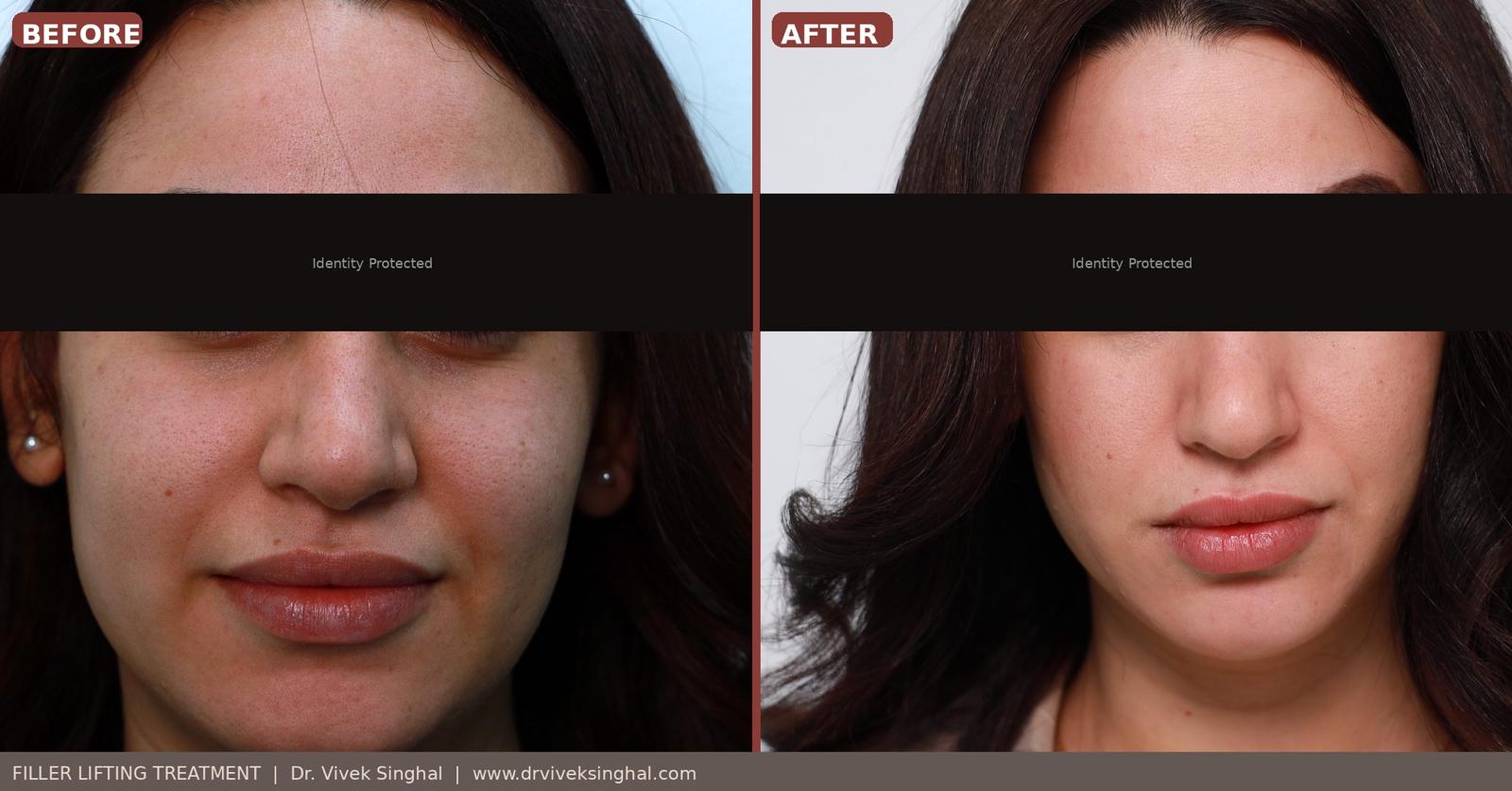
The patient results below demonstrate the clinical outcome of combining the correct filler rheology, anatomically specific injection points and appropriate tissue plane targeting. The changes visible at one week post-treatment reflect structural repositioning rather than simple volumisation.
Image: liquid-facelift-result2-dr-vivek-singhal.jpg
Alt text: Filler facial lifting before and after one week – high G prime filler with precise injection points and planes by Dr.Vivek Singhal
Note the following in the after image:
- Upward rotation of the mid-face soft tissue
- Improved definition of the cheekbone without excess lateral projection
- Reduction in nasolabial fold depth as a consequence of mid-face lift (not direct fold filling)
- Improved jawline definition
- No increase in lower face heaviness – the result is lifted, not filled
This is what precision technique with appropriate product selection produces. The total volume used was conservative — the outcome is determined by placement, not quantity.
5 Myths About Fillers for Lifting — Debunked
Myth 1: “You need a lot of filler to see a lifting result.” This is perhaps the most harmful misconception in aesthetic medicine. Volume alone does not lift. A large quantity of filler placed without a structural rationale adds mass to the face – and mass descends with gravity. Genuine lifting results from correct placement of smaller quantities at anatomically strategic points. Many of Dr. Vivek Singhal’s most impressive lifting outcomes use 1 to 2 syringes placed with precision, not 4 to 6 placed generously.
Myth 2: “Filling the nasolabial folds directly is the right treatment for smile lines.” Direct injection into the nasolabial fold is one of the most frequently requested and most frequently over-performed procedures in aesthetic medicine. The fold is a consequence of mid-face descent – filling it directly treats the symptom without addressing the cause. A structural mid-face lift using high G’ filler at the malar eminence and sub-malar region reduces the nasolabial fold depth as a natural consequence of repositioning the tissue above it. No direct fold injection required, and the result looks significantly more natural.
Myth 3: “All fillers do the same thing.” Hyaluronic acid fillers span an enormous range of physical properties. A lip filler and a structural cheek filler are as different from each other as modelling clay is from concrete. Using a soft, low G’ filler in a structural lifting location is like building a column out of foam — it looks like it should work, but it deforms under load. Product selection must be matched to the mechanical demands of the injection site.
Myth 4: “Filler lifts work the same way regardless of which doctor performs them.” The knowledge required to perform lifting-specific filler treatment safely and effectively is genuinely specialist-level. It requires a thorough understanding of facial anatomy —including the vascular anatomy, which in the wrong hands carries serious risk — as well as fluency with filler rheology and the biomechanics of soft tissue support. The same syringe of filler produces dramatically different results depending on the training and technique of the person injecting it.
Myth 5: “If filler doesn’t work for lifting, you need surgery.” For the right candidate, precision filler-based lifting can achieve outcomes that genuinely rival early surgical intervention — without anaesthesia, incisions, scarring or weeks of recovery. The key is an honest assessment of whether the patient’s degree of tissue laxity and volume loss falls within the range where non-surgical treatment is truly effective. Dr. Vivek Singhal will always give you a frank assessment of what is and is not achievable without surgery.
Who Is a Good Candidate for Lifting Fillers?
The best results from structural filler lifting are seen in patients who have:
- Early to moderate mid-face descent
- Volume loss in the cheeks, temples or lower face
- Nasolabial folds or early jowling driven by mid-face ptosis rather than pure skin laxity
- Good skin quality with reasonable elasticity
- Realistic expectations about the degree of improvement achievable non-surgically
Patients with very significant skin laxity, advanced jowling or major soft tissue ptosis may be better served by a surgical consultation. Dr. Vivek Singhal will always tell you honestly which category you fall into — and will never recommend filler as a substitute for a surgical result it cannot replicate.
What to Expect from Your Lifting Filler Treatment
Consultation
A detailed assessment of your facial anatomy, ageing pattern, skin quality and goals. Dr. Singhal will explain exactly which points he is targeting, which filler he is selecting and why, and what result you can realistically expect.
The Treatment
A structural lifting treatment typically takes 30 to 60 minutes. High G’ fillers placed supraperiosteally require slow, controlled injection technique. A blunt cannula is often used for certain planes to minimise bruising and reduce vascular risk. Some tenderness at injection points is normal.
Immediately After
Mild swelling and occasional bruising at injection sites is normal, particularly at bony points. Most patients resume normal activities the same day. Exercise, alcohol and heat should be avoided for 24 hours.
Seeing the Results
Initial lift is visible immediately. As post-injection swelling resolves over 7 to 14 days, the final result becomes apparent. The images in this article were photographed at one week – results continue to refine slightly through the second week.
Longevity
High G’ structural fillers at supraperiosteal planes typically last longer than softer fillers placed superficially – commonly 12 to 24 months depending on the product and individual metabolism. Maintenance treatments at appropriate intervals sustain the result effectively.
Why Choose Dr. Vivek Singhal for Lifting Filler Treatment?
Dr. Vivek Singhal’s approach to facial lifting with fillers is built on anatomical precision, appropriate product selection and a commitment to natural, structurally sound results. He does not treat faces generically – every treatment plan is designed around the individual’s specific anatomy, ageing pattern and goals.
His philosophy: the right product, in the right plane, at the right point — in the smallest quantity needed to achieve the result.
This approach consistently produces outcomes that look like the patient simply looks better – not like they’ve had filler.
Frequently Asked Questions
Is lifting filler treatment painful? Supraperiosteal injection at bony points can involve brief, sharp discomfort as the needle contacts the periosteum. Topical anaesthetic and filler containing lidocaine make the experience very manageable. Most patients tolerate the procedure well.
How is this different from regular filler treatment? Standard filler treatment focuses on filling wrinkles, lines and hollows. Lifting filler treatment focuses on restoring structural support points, working in the supraperiosteal plane and selecting high G’ products specifically for their mechanical properties. The goals, techniques and product choices are meaningfully different.
Can I combine lifting fillers with Botox? Yes — and it is often optimal to do so. Botox addresses downward-pulling muscle vectors (brow depressors, platysma bands, masseter)that counteract the lifting effect of filler. Together they produce a more comprehensive and longer-lasting result.
How many syringes will I need? Structural lifting does not require large volumes. Most patients achieve meaningful results with 1 to 3 syringes placed strategically. Dr. Singhal will always recommend the minimum effective quantity and build conservatively from there.
Is it safe? When performed by a practitioner with thorough knowledge of facial vascular anatomy, lifting filler treatment has an excellent safety profile. Dr. Singhal uses blunt cannulas wherever appropriate to further minimise vascular risk and always has hyaluronidase available for emergency use.
How soon can I have my next treatment? Results should be fully assessed at 2 weeks before planning any additions. Maintenance treatments are typically recommended at 12 to 18 month intervals.
Book Your Liquid Facelift Consultation
If you are considering filler treatment for facial lifting and want to understand exactly what is possible for your face, the first step is a consultation with Dr. Vivek Singhal.
Dr. Vivek Singhal — 09 Clinic
Book your consultation at www.drviveksinghal.com